
Taxpayer Privacy vs. Underwriting Rules: What You Must Protect
Whether you are securing a residential mortgage underwritten by Fannie Mae or Freddie Mac, applying for institutional university financial aid via the CSS Profile, closing a commercial working capital loan, or executing a matrimonial asset disclosure in family court, supplying your past two years of federal income tax returns is an unavoidable prerequisite. Your IRS Form 1040 (U.S. Individual Income Tax Return) serves as the definitive legal benchmark of household earnings. With our edit a scanned PDF, everything runs locally in your browser with zero file uploads.
However, your Form 1040 is also the single most hazardous document in your financial portfolio to transmit across digital channels without comprehensive redaction. An unredacted Form 1040 discloses every critical data point needed to execute synthetic identity theft and unauthorized bank takeovers: full legal names, primary Social Security numbers, spouses' SSNs, the names and 9-digit SSNs of minor dependent children, residential street addresses, and direct deposit checking and transit routing codes printed explicitly on Lines 35b through 35d. Transmitting this raw document over email or uploading it to unsecured commercial loan portals exposes your entire household to grave cybersecurity vulnerabilities.
Yet, millions of taxpayers execute redactions that catastrophically backfire. Many applicants black out critical financial metrics—such as Adjusted Gross Income (AGI on Line 11), Total Income (Line 9), or accompanying schedule losses—causing mortgage loan underwriters to halt approvals immediately. Worse, other applicants utilize superficial markup pens or desktop shape overlays: drawing an opaque black rectangle over vector text in standard desktop viewers is NOT true redaction. Underneath that graphic box, the underlying vector font glyphs generated by digital tax software remain completely intact, allowing anyone receiving the PDF to copy and paste your full Social Security number into Notepad with Ctrl + C.
In this comprehensive guide, discover the exact federal standards governing tax return sanitization, learn how to separate mandatory financial metrics from redactable personal identifiers, and master client-side WebAssembly redaction that permanently destroys sensitive characters with zero cloud server upload risk.
4 Steps to Redact Form 1040 Tax Return on EditScannedPDF.com
Sanitizing your federal tax return requires zero software installation, zero account registrations, and zero server uploads. Follow this simple 4-step workflow to permanently destroy confidential household identifiers while preserving all essential income verification figures:
Ingest Form 1040 into Local RAM
Open EditScannedPDF.com and select the Erase & Highlight PDF tool. Drag your IRS Form 1040 PDF into the browser. The file renders locally in client-side memory via WebAssembly with zero server upload.
Protect Core Income Verification Lines
Keep your legal name, filing status, Adjusted Gross Income (Line 11), Total Tax (Line 24), and Schedule C/E business earnings 100% visible and untouched for loan underwriters.
Apply Destructive Redaction Boxes
Select the Blackout tool. On Page 1, black out dependent children's SSNs and mask the first 5 digits of your SSN. On Page 2, completely blackout Lines 35b-d (bank routing and account numbers).
Bake & Export Flattened PDF
Click Preview & Download. The WebAssembly engine scrubs underlying vector text streams, bakes solid pixel fills into the canvas, and exports an unhackable, lender-compliant PDF.
Technical Under-the-Hood: In-Browser Wasm Redaction Workflows
Digital tax returns generated by modern consumer and commercial tax filing software (including commercial tax suites and CPA filing packages) are compiled as pure, vector-rendered digital PDF documents. Unlike scanned physical papers, digital returns store every digit of your Social Security number, employer identification number (EIN), and bank routing coordinates as high-precision PostScript vector font glyphs:
- The Fatal Vulnerability of Vector Text Overlays: When an applicant draws a black rectangle in basic viewer software, the application merely inserts an opaque vector path into the visual display layer. The underlying font glyph objects (such as `123-45-6789`) remain entirely unchanged in the document's content stream. Any recipient can simply drag their cursor across the black rectangle, copy the text to clipboard, and view the raw Social Security number in plain text.
- Cryptographic Glyph Excision in Browser RAM: EditScannedPDF.com eliminates this vulnerability through client-side WebAssembly execution. When you draw a redaction envelope, our browser runtime parses the internal PDF object tree, locates the precise bounding box coordinates of the underlying font characters, and physically removes the character byte descriptors from the document's content stream.
- Irreversible Raster Flattening: Upon export, the engine bakes the redaction boxes directly into an immutable raster bitmap substrate. All underlying OCR text layers, embedded font subsets, and XML document metadata dictionaries are completely stripped, making forensic or algorithmic text extraction mathematically impossible.
Precision Tax Package Sanitization on Desktop Workstations: Federal tax filings routinely include Form 1040 alongside extensive supplemental schedules (Schedule 1, Schedule A, Schedule C, Schedule E, Schedule SE). Utilize desktop workstations for multi-page precision editing:
- Load Tax Return in Browser: Open Chrome, Edge, Firefox, or Safari and drag your multi-page Form 1040 package into the Erase & Highlight PDF tool. The file parses locally in browser memory with zero cloud transfer.
- Navigate Multi-Page Schedules: Use the visual page thumbnail strip to review Page 1 (core filer info), Page 2 (refund lines), and subsequent business schedules.
- Apply Millimeter-Accurate Bounding Boxes: Click the Blackout tool. On Page 1, draw clean marquee boxes over dependent children's SSNs. On Page 2, black out Lines 35b-d (routing and account numbers). On Schedule C, mask personal home telephone numbers or private EINs if required.
- Export Lender-Compliant PDF: Click Preview & Download. The WebAssembly compiler flattens all layers, producing an immutable, underwriter-ready PDF saved directly to your local drive.
Mobile Tax Return Sanitization for Smartphone & Tablet Users: If you downloaded your filed tax return from an online tax portal or email on your iPhone, iPad, or Android phone, sanitize it before submitting it to loan brokers or landlords:
- Launch Mobile Browser: Navigate to EditScannedPDF.com in Safari or Chrome. Tap the file upload button to import your tax return PDF from iCloud Drive, Google Drive, or the local Files app.
- Pinch-to-Zoom Precision: Use standard two-finger pinch gestures to zoom into fine tabular line items, such as the Dependents table on Page 1 or the direct deposit numbers on Page 2.
- Touch-Optimized Drag Handles: Tap the Redact tool and drag your finger across sensitive numeric strings. Use the dynamic touch handles to ensure complete coverage of Social Security numbers without obscuring adjacent filing names.
- Save to Device Storage: Tap Download. Your mobile browser generates and saves the flattened PDF directly into your device's local Downloads folder using zero cellular upload data.
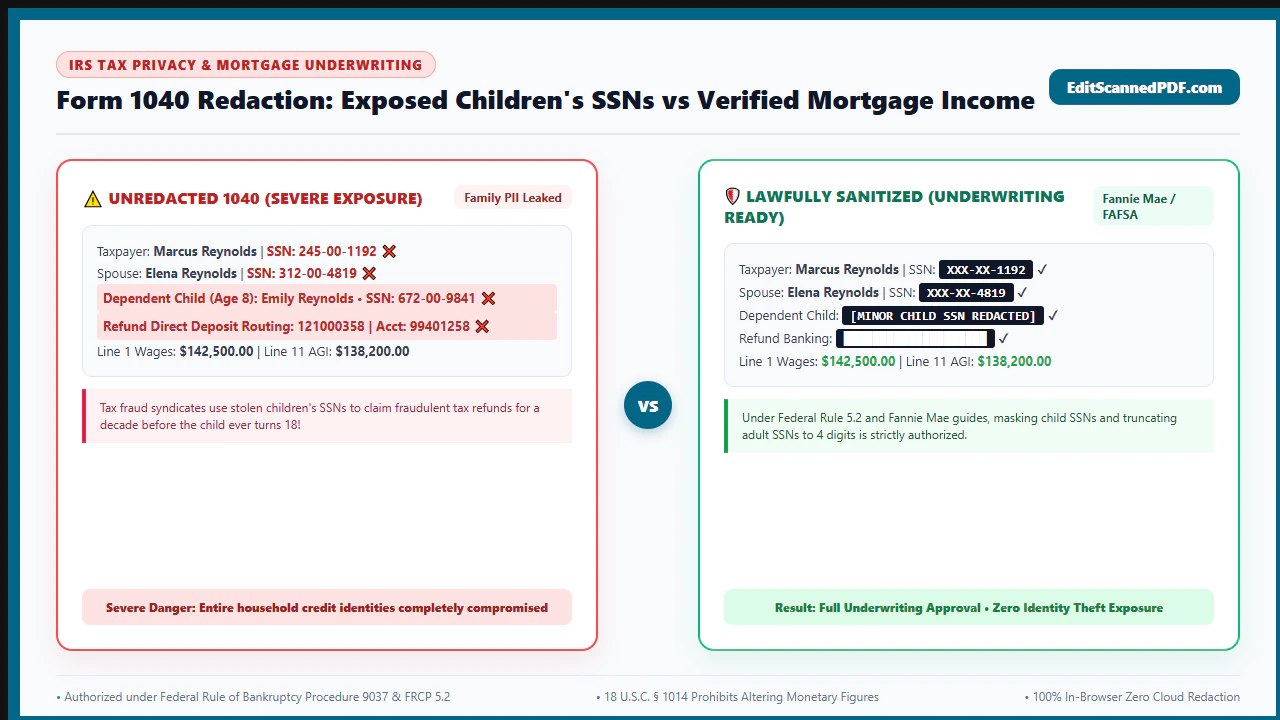
Form 1040 Data Taxonomy & Enterprise Financial Use Cases
Successfully redacting a tax return requires understanding the strict operational boundary between mandatory income verification lines and high-risk personal identification fields. Here is the operational tax data taxonomy across Form 1040:
1. Mandatory Verification Fields (Must Remain 100% Intact)
- Full Legal Name & Filing Status: Proves whether you filed as Single, Married Filing Jointly, Married Filing Separately, or Head of Household.
- Total Income (Line 9): Sum of W-2 wages, taxable interest, ordinary dividends, IRA distributions, pensions, and capital gains.
- Adjusted Gross Income (Line 11 - AGI): The foundational figure used by mortgage loan underwriters to compute your Debt-to-Income (DTI) ratio. Obscuring Line 11 causes automatic application rejection.
- Standard or Itemized Deductions (Line 12): Substantiates deductions claimed on Schedule A.
- Total Tax & Federal Withholding (Lines 24 & 33): Verifies overall federal tax liability and taxes withheld from W-2s or 1099s.
- Supplemental Schedules (Schedule 1, Schedule C, Schedule E): Required for self-employed individuals and rental property owners to calculate net cash flow and add back paper depreciation.
2. High-Risk Redactable Fields (Safe & Recommended to Black Out)
- Direct Deposit Bank Routing & Account Numbers (Lines 35b, 35c, 35d): Discloses your financial institution's 9-digit routing transit code and personal checking/savings account number. Always black out these lines completely. Lenders verify bank accounts through official bank statements, not tax refund fields.
- Minor Dependent Children Social Security Numbers: Protect minor children from synthetic identity theft by blacking out full 9-digit SSNs in the Dependents box on Page 1.
- Spouse Social Security Number (Individual Applications): If applying for individual credit or loans without a co-borrower, mask your spouse's SSN or truncate to the last 4 digits.
- Third-Party Designee PIN: The personal 5-digit PIN authorizing third-party discussion with the IRS on Page 2 should be blacked out.
- Paid Preparer PTIN / SSN: If your CPA or tax preparer used a personal SSN rather than a corporate EIN on Page 2, mask the identifier.
1. Mortgage Underwriting (Fannie/Freddie)
Underwriting Rule: Fannie Mae Selling Guide B3-3.1-01 requires verification of stable income via Form 1040 and IRS Form 4506-C transcripts.
Redaction Protocol: Mask the first 5 digits of your primary SSN (e.g., ***-**-1234), redact dependent children's SSNs completely, and erase Lines 35b-d direct deposit bank routing numbers. Ensure all schedules (1, C, E) remain fully legible.
2. University Financial Aid (FAFSA / CSS)
Compliance Rule: Family Educational Rights and Privacy Act (FERPA) and institutional financial aid documentation mandates.
Redaction Protocol: University financial aid offices explicitly request that families black out all household Social Security numbers and bank routing details before uploading tax returns to institutional portals to prevent identity exposure.
3. Commercial Loans & Business Transactions
Compliance Rule: Small Business Administration (SBA 7(a)) loans and corporate partner due diligence.
Redaction Protocol: Redact personal banking numbers and family dependent SSNs while leaving Schedule C business income, Schedule K-1 partnership distributions, and gross revenue figures completely visible.
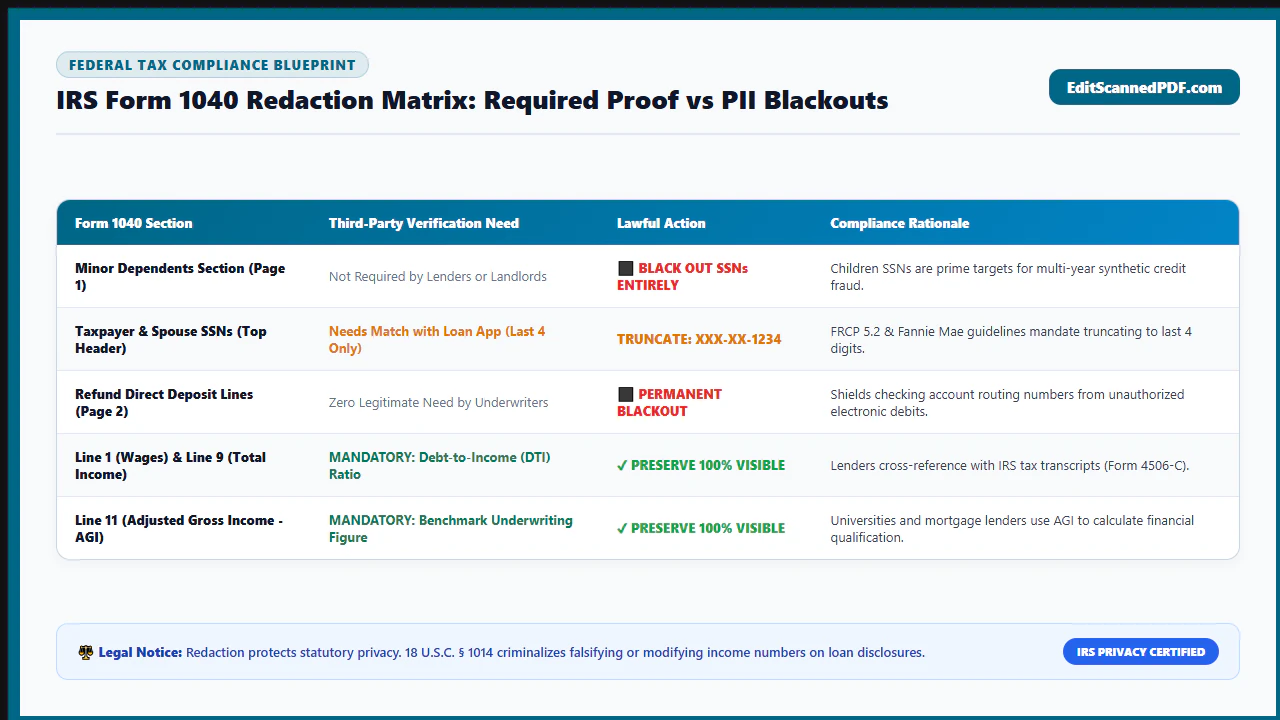
Redaction Methods Compared: Tax Security & Privacy Benchmarks
Taxpayers and financial professionals cannot afford superficial document masking. The following comprehensive benchmark compares four common document redaction methods across critical regulatory compliance, identity security, and operational criteria:
| Redaction Methodology | Identity Security Level | Cloud Privacy Risk | Forensic Text Recovery | Annual Cost & License |
|---|---|---|---|---|
| Desktop Viewer Shape Overlay | Zero (Unsafe) | Low (Local app) | 100% Recoverable (Select & Delete) | Free / Native |
| Standard Cloud PDF Converters | Moderate | Severe (Uploaded to Cloud Servers) | Variable by converter | Freemium / Account required |
| Commercial Desktop Suites | High | Low (Local installation) | Permanently Destroyed | Expensive ($240/user/year) |
| EditScannedPDF.com (Client Wasm) | Maximum Enterprise | Zero (100% In-Browser Memory) | Permanently Purged & Flattened | 100% Free / No Account Needed |
Recommended Companion Tools for Tax Document Preparation
Preparing a comprehensive, lender-compliant tax submission frequently involves extracting specific forms, removing passwords, or reducing file size. Pair our redaction engine with these specialized in-browser utilities:
| Tool Name | Tax Document Preparation Function | Recommended Financial Workflow |
|---|---|---|
| Split PDF Documents | Extract Form 1040 from bloated 60-page tax software returns | Separate core 2-page Form 1040 and Schedule C from 40 pages of internal calculation worksheets and diagnostic diagnostic notes. |
| Unlock PDF Tool | Decrypt CPA password-protected tax returns | Remove view restrictions on CPA-encrypted tax filings locally in memory before applying redactions. |
| Compress PDF to 100KB | Downsample multi-year tax return packages | Shrink bloated 35 MB scan bundles into compact 300 DPI files that satisfy mortgage portal upload caps. |
| Lock PDF Tool | Encrypt sanitized returns with AES-256 protection | Add a custom recipient password before emailing finalized redacted returns to mortgage brokers or loan officers. |
| Merge PDF Documents | Consolidate disparate tax documents into a unified file | Combine Form 1040, Form W-2s, 1099 statements, and bank verification letters into a single chronological financial dossier. |
Federal Privacy Standards, Pro Tip & Anti-Fraud Notice
Tax return confidentiality is governed by strict federal statutory safeguards. Under Internal Revenue Code (26 U.S.C. § 6103), federal tax returns and return information are confidential and protected from unauthorized disclosure. Furthermore, under the Gramm-Leach-Bliley Act (GLBA, 15 U.S.C. § 6801), financial institutions and mortgage lenders have an affirmative legal duty to safeguard non-public personal information (NPI).
Federal guidelines actively encourage applicants to redact non-essential sensitive identifiers—specifically bank direct deposit routing numbers and minor dependent Social Security numbers—to prevent identity theft and account draining. However, loan applicants must navigate the critical boundary between legal privacy protection and criminal loan fraud.
When preparing tax returns for mortgage underwriting, never black out the primary filer's Social Security number 100%. Underwriters cross-reference your submitted Form 1040 against official IRS tax transcripts obtained via Form 4506-C. If your SSN is completely obscured, underwriting automated verification software will reject the document. Always apply the Truncation Protocol: mask only the first 5 digits (e.g., ***-**-1234) so the last 4 digits remain legible for cross-referencing against your W-2s and credit report.
Lawful Privacy Minimization: Redacting non-essential personal identifiers—including direct deposit bank routing numbers (Lines 35b-d), dependent children's SSNs, and third-party PINs—is completely lawful and recognized under federal privacy guidelines to protect against identity theft.
Severe Federal Felony Warning (18 U.S.C. § 1014): Knowingly altering, inflating, or falsifying income figures, tax withholdings, or schedule line items (such as manipulating Adjusted Gross Income on Line 11 or omitting business losses on Schedule C) on any loan or mortgage application constitutes a severe federal felony under 18 U.S.C. § 1014 (False Statements on Loan and Credit Applications), carrying penalties of up to 30 years in federal prison and $1,000,000 in fines. Redaction must strictly protect identity—never alter financial facts.
- check_circle Visual Masking Fails on Digital Tax Returns: Drawing black rectangles leaves underlying vector text completely extractable with Ctrl+C. Use true glyph destruction.
- check_circle Always Redact Direct Deposit Lines 35b-d: Form 1040 exposes your bank transit routing and account numbers; blacking them out prevents ACH fraud.
- check_circle Never Alter Financial Income Figures: Keep Adjusted Gross Income (Line 11), Total Income (Line 9), and schedules intact to avoid federal loan fraud under 18 U.S.C. § 1014.
- check_circle 100% In-Browser WebAssembly Privacy: EditScannedPDF.com processes tax returns locally in device RAM with zero server uploads and zero cloud footprint.
To safely redact Social Security Numbers (SSN), dependents' identities, and banking details on IRS Form 1040 tax returns before sending them to lenders or colleges, use the EditScannedPDF Redaction Tool. It executes permanent, unrecoverable pixel redaction directly in client-side memory without uploading your tax return to any external cloud server.
Protect Your Household Tax Privacy Before Applying
Permanently sanitize Social Security numbers, bank routing codes, and dependent details with 100% in-browser WebAssembly encryption. Zero uploads. Zero cloud logs. Total peace of mind.
shield Redact Tax Return PDF NowFrequently Asked Questions About Form 1040 Redaction
Is it legal to redact my Form 1040 tax return before giving it to a mortgage lender?
Yes, it is legal and standard practice to redact non-essential personal identifiers such as dependent children's Social Security numbers and personal bank direct deposit details (lines 35b-d). However, under 18 U.S.C. § 1014, you must never alter, falsify, or modify any financial figures, including your Adjusted Gross Income (Line 11), Total Income (Line 9), taxable wages, or business revenue on Schedule C. Making false statements on loan applications is a federal crime.
What parts of Form 1040 does a mortgage underwriter actually need to verify?
Mortgage underwriters following Fannie Mae, Freddie Mac, or FHA guidelines need to verify: (1) Your full legal name and filing status, (2) Adjusted Gross Income (Line 11), (3) Total tax liability and W-2 withholdings, (4) Accompanying schedules such as Schedule 1 (additional income/losses) and Schedule C/E (business or rental income), and (5) The IRS e-file acceptance confirmation or filing signature. Everything else—including banking details and minor dependent SSNs—can be safely redacted.
Can I black out my spouse's Social Security number on a joint Form 1040?
If you are applying for credit, a personal loan, or a scholarship individually in your own name, you can safely redact your spouse's Social Security number to protect their identity. However, if you and your spouse are co-borrowers applying jointly for a mortgage, both spouses' identities must be verified by the lender, so only the first 5 digits of each SSN should be masked (e.g., ***-**-1234).
Why is blacking out direct deposit numbers on lines 35b-d so critical?
Lines 35b, 35c, and 35d on Form 1040 explicitly display your bank's 9-digit routing transit number, whether the account is checking or savings, and your full direct deposit bank account number. Transmitting this unredacted to loan brokers, universities, or landlords exposes your checking account to unauthorized ACH debit fraud and identity theft. Always black out these banking fields.
Why can't I just draw black boxes in standard desktop PDF readers or native preview utilities?
Standard desktop PDF viewers merely place an aesthetic black box annotation on top of the document canvas. The underlying computer vector text—generated by digital tax software—remains 100% intact beneath the box. Anyone receiving the PDF can highlight the area, copy it to clipboard, or inspect the PDF object stream to read your full Social Security number and bank coordinates. True redaction requires permanent glyph destruction and layer flattening.
Can I redact my tax return for university financial aid (FAFSA / CSS Profile)?
Yes. University financial aid offices and the College Board CSS Profile routinely instruct applicants to black out all Social Security numbers and bank routing numbers on supporting tax documents before uploading them to institutional document portals to comply with federal student privacy standards (FERPA).
What should I do if my tax return PDF is password-protected by my CPA?
CPAs and professional tax software frequently lock exported returns with a client password (often the last 4 digits of your SSN). Before redacting, use our in-browser Unlock PDF tool to decrypt the file locally in memory. Once unlocked, you can safely redact sensitive identifiers, flatten the document, and export a lender-compliant PDF.