
The Dangerous Trap of "Cosmetic Redaction" in Healthcare
Navigating patient health records, hospital discharge summaries, clinical research data sets, and medical billing documentation in the United States requires uncompromising adherence to federal statutory privacy standards. Under the Health Insurance Portability and Accountability Act of 1996 (HIPAA), sharing electronic health records (EHR) or paper scans containing unredacted Protected Health Information (PHI) exposes healthcare providers, law firms, clinical researchers, and medical billing agencies to devastating regulatory audits and civil monetary penalties exceeding millions of dollars. With our edit scanned PDF, everything runs locally in your browser with zero file uploads.
Whether you are a litigation paralegal assembling records for personal injury discovery, a hospital compliance officer responding to an administrative subpoena, a clinical trial coordinator anonymizing participant registries, or an individual submitting healthcare expenses for worker's compensation reimbursement, learning how to permanently redact medical records in PDF format is paramount. Yet, an alarming percentage of medical office staff and legal teams unknowingly commit catastrophic privacy breaches: they confuse cosmetic visual masking with true destructive redaction.
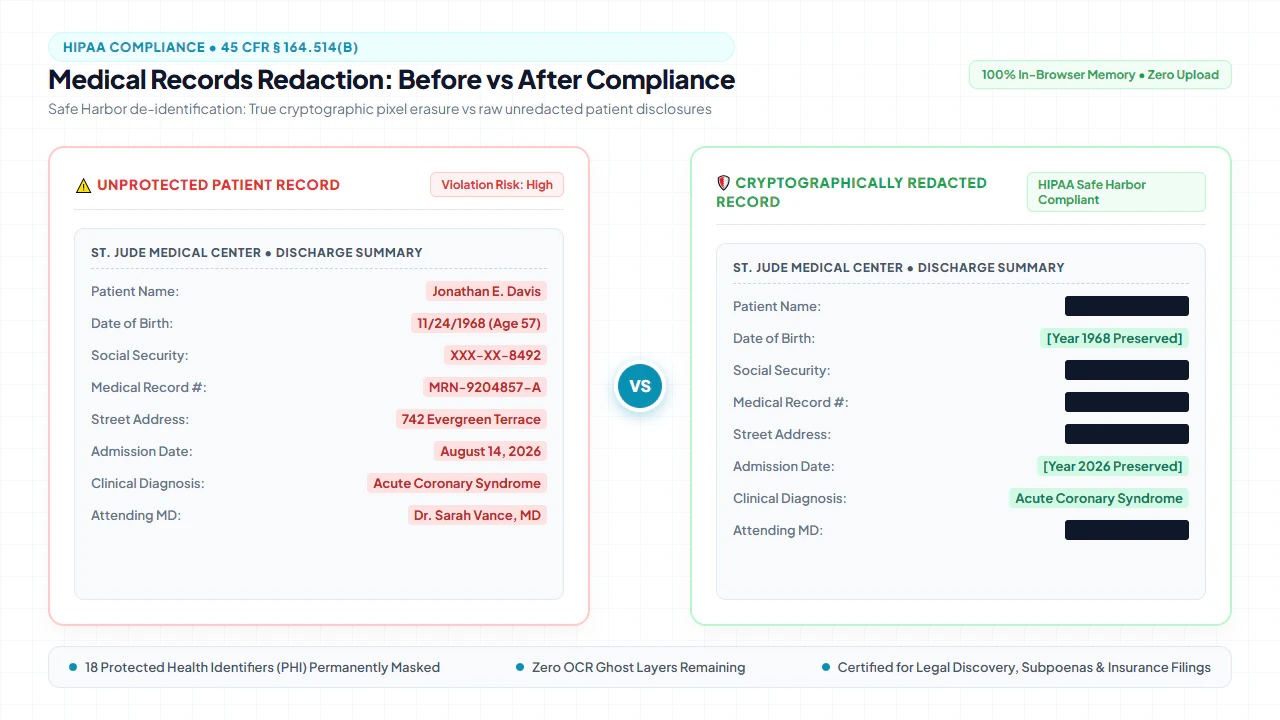
In standard desktop document viewers, mobile markup utilities, or generic print-to-PDF tools, drawing a black rectangle or thick dark highlighter stroke over a patient's name, diagnosis, or Social Security number merely appends an overlay shape into the uppermost PDF annotation dictionary. Underneath that superficial visual mask, the original optical character recognition (OCR) text stream, font glyph coordinates, and high-resolution clinical bitmap pixels remain 100% intact. Anyone receiving the file in standard PDF software can select the black rectangle with their mouse, press Delete, or press Ctrl + A and Ctrl + C to copy the invisible underlying text directly into Notepad.
True legal and clinical redaction requires permanent, irreversible pixel and vector destruction. When executed inside local device RAM via client-side WebAssembly on EditScannedPDF.com, every character code, metadata field, and underlying bitmap pixel within the designated bounding box is mathematically purged and overwritten with solid color bytes before the document is flattened. This ensures that no forensic software, text extraction script, or AI vision model can ever unmask the patient's identity.
4 Steps to Redact Medical Records on EditScannedPDF.com
Sanitizing patient charts and medical invoices requires zero software installation, zero account sign-ups, and zero server uploads. Follow this simple 4-step workflow to permanently de-identify clinical records while maintaining strict HIPAA compliance:
Ingest Record into Local RAM
Open EditScannedPDF.com and select the Erase & Highlight PDF tool. Drag your medical record into the workspace. The file renders locally in browser memory via WebAssembly without uploading bytes to remote cloud servers.
Identify All 18 PHI Targets
Review the medical document systematically. Locate direct patient identifiers including full legal name, Medical Record Number (MRN), dates of service, street addresses, and attending physician notes.
Apply Permanent Redaction Boxes
Select the Blackout Redaction tool or Whiteout Eraser. Draw millimeter-precise marquee boxes over every sensitive entry. The tool overwrites underlying image pixels and purges vector glyphs in real time.
Export Cryptographically Flattened PDF
Click Preview & Download. The WebAssembly engine flattens the canvas, stripping away hidden OCR text streams and EXIF scanner metadata, producing a court-ready, de-identified PDF.
Technical Under-the-Hood: In-Browser Wasm Redaction Workflows
Under the HIPAA Security Rule (45 CFR Part 160 and Part 164, Subparts A and C), covered entities and business associates are legally mandated to implement technical safeguards that prevent unauthorized transmission of electronic Protected Health Information over open communications networks. When organizations utilize conventional cloud-based PDF web tools, they violate this core rule by transmitting unencrypted or remotely decrypted patient charts to shared server clusters.
EditScannedPDF.com re-engineers document processing by bringing enterprise-grade PDF compilation entirely inside your client-side web browser using WebAssembly (Wasm), HTML5 Canvas rendering APIs, and typed array memory buffers:
- Complete Air-Gapped Local Processing: The entire PDF parsing, font rasterization, and vector manipulation engine executes inside your browser's local sandbox. No document pages, medical charts, or patient diagnostics are ever transmitted over the network. You can disconnect your internet connection immediately after the page loads, and the redaction engine continues running seamlessly.
- Sub-Pixel Coordinate Mapping: When you drag a marquee redaction box across a medical scan, the browser engine maps the bounding box to the exact hardware resolution coordinates of the underlying 300 DPI or 600 DPI document bitmap. Every pixel within that coordinate matrix is overwritten with solid opaque RGB bytes (`#000000`).
- Destructive Canvas Flattening & OCR Elimination: Scanned clinical records frequently harbor invisible underlying OCR text layers generated by multifunction office scanners. Our export engine reconstructs the entire document into an immutable, flattened raster stream, completely extinguishing ghost OCR characters, search indexing trees, and revision history dictionaries.
High-Throughput Clinical Chart Processing for Legal & Healthcare Workstations: Medical records frequently span dozens of complex multi-page laboratory panels, doctor progress notes, and diagnostic radiology reports. Utilize desktop workstations for maximum efficiency:
- Open Workspace in Desktop Browser: Launch Chrome, Edge, Firefox, or Safari and access the Erase & Highlight PDF tool. Drop your multi-page medical PDF directly into the canvas.
- Multi-Page Page Navigator: Use the thumbnail sidebar to navigate quickly between clinical narrative pages, lab test matrices, and pharmacy ledger sheets.
- Precision Marquee Redaction: Click and drag precision bounding boxes across tabular rows. Black out patient admission timestamps, MRN header strings, and attending nurse signatures without obscuring vital clinical treatment descriptions.
- One-Click Flattened Export: Click Preview & Download. The WebAssembly runtime bakes all redaction boxes into the raster canvas in seconds, downloading the finalized HIPAA-compliant PDF to your local drive.
On-the-Go Patient Health Record Redaction for Mobile Devices: If you downloaded your medical chart or lab panel from a patient portal (MyChart, Quest Diagnostics, Labcorp) onto your iPhone, iPad, or Android phone, sanitize it before emailing insurance adjusters or employers:
- Open Mobile Browser: Launch Safari on iOS or Chrome on Android and navigate to EditScannedPDF.com. Tap the file upload button to import your medical PDF from the Files app, iCloud Drive, or Google Drive.
- Pinch-to-Zoom Precision: Use standard two-finger pinch gestures to magnify fine 8pt laboratory print, such as patient account numbers or diagnostic specimen collection timestamps.
- Touch-Optimized Redaction Handles: Tap the Redaction tool and swipe your finger over sensitive identifiers. Use dynamic edge handles to adjust bounding boxes so confidential patient details are covered while preserving clinical test results.
- Download Directly to Device: Tap Download. Your mobile browser generates and saves the flattened, de-identified PDF to your local Downloads folder using zero cellular upload data.
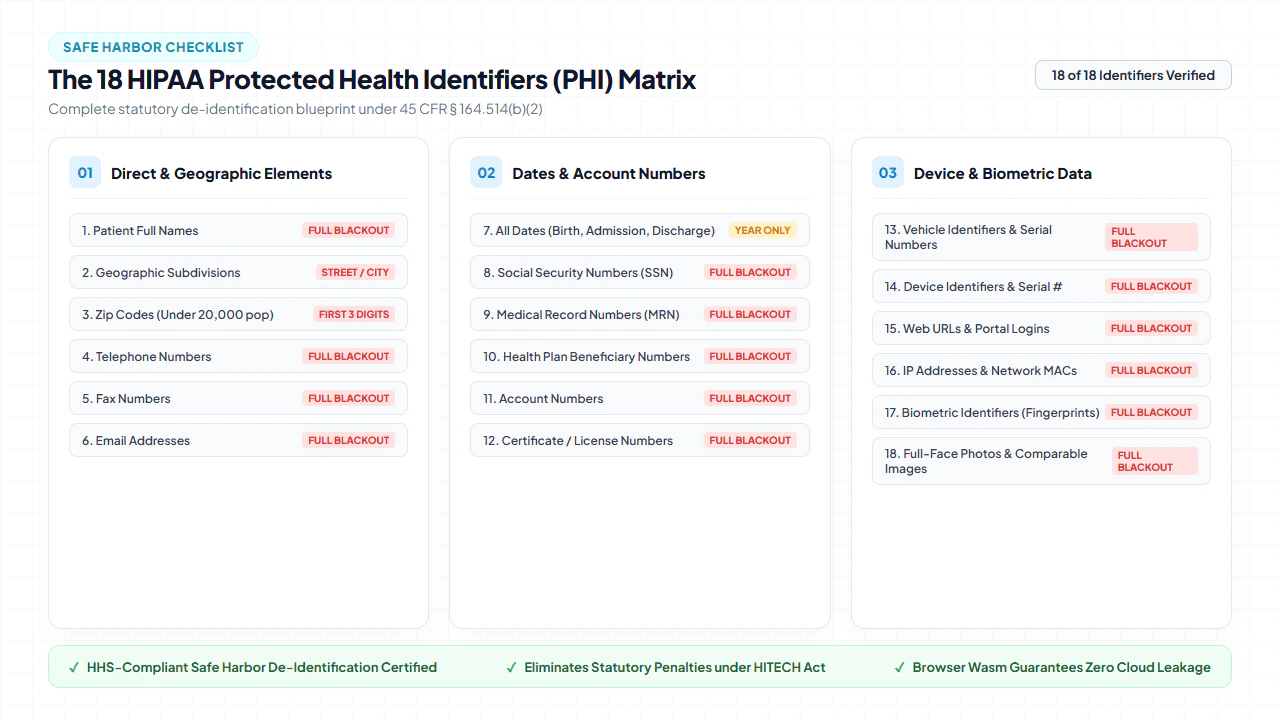
The 18 PHI Identifiers & Enterprise Clinical Use Cases
Under the Health and Human Services (HHS) Safe Harbor de-identification method (45 CFR § 164.514(b)(2)), health information is deemed non-identifiable only after all 18 of the following direct and indirect patient identifiers are completely purged from both the document visual substrate and underlying electronic metadata:
- Names: Full legal names, maiden names, middle initials, aliases, and legal guardian designations.
- Geographic Subdivisions: All geographic data smaller than a state, including street addresses, city names, counties, precincts, and corresponding ZIP codes (except initial three digits under strict census population criteria).
- Dates Related to an Individual: Birth dates, admission dates, discharge timestamps, surgery dates, and dates of death. Ages 90 or older must be aggregated into an 90+ category.
- Telephone Numbers: Home, mobile, office, and emergency contact phone lines.
- Fax Numbers: Primary clinic, pharmacy, and hospital department fax numbers.
- Email Addresses: Personal, employer, and caregiver electronic mail addresses.
- Social Security Numbers (SSN): Full 9-digit or partial truncated tax and identity strings.
- Medical Record Numbers (MRN): Internal healthcare system tracking codes and patient chart serials.
- Health Plan Beneficiary Numbers: Medicare, Medicaid, and private commercial insurance policy numbers.
- Account Numbers: Hospital billing accounts, patient ledger numbers, and financial tracking codes.
- Certificate & License Numbers: Medical marijuana cards, organ donor certificates, and driver's licenses.
- Vehicle Identifiers: License plate numbers, vehicle registration certificates, and VIN numbers.
- Device Identifiers & Serial Numbers: Cardiac pacemakers, insulin pumps, orthopedic implants, and prosthetic serial codes.
- Web Universal Resource Locators (URLs): Personal websites or direct clinical patient portal hyperlinks.
- Internet Protocol (IP) Addresses: Digital network addresses logged during telehealth video appointments.
- Biometric Identifiers: Fingerprints, voiceprints, iris/retina scans, and full-palm impressions.
- Full-Face Photographic Images: Headshots, clinical plastic surgery photos, and patient diagnostic portraits.
- Any Other Unique Identifying Characteristic: Case accession numbers or distinguishing clinical markings.
1. Legal E-Discovery & Subpoenas
Compliance Standard: Federal Rule of Civil Procedure 5.2 and state court evidentiary rules.
Redaction Mandate: In medical malpractice, personal injury, and worker's compensation litigation, defense and plaintiff attorneys must sanitize third-party medical histories, unrelated prior surgeries, and unessential personal identifiers before filing exhibits on public CM/ECF court dockets.
2. Clinical Research & Academic Registries
Compliance Standard: Institutional Review Board (IRB) and 45 CFR § 164.514 Safe Harbor.
Redaction Mandate: Academic medical centers and pharmaceutical clinical trial sponsors must de-identify real-world patient records before sharing diagnostic charts with data analysts, overseas biostatisticians, or peer-reviewed medical journals.
3. Patient Submissions & Disability Appeals
Compliance Standard: Individual Privacy Rights under HIPAA Privacy Rule.
Redaction Mandate: Patients filing for Social Security Disability Insurance (SSDI), employer accommodations, or health insurance coverage appeals frequently need to redact sensitive psychiatric evaluations, family genetic histories, or unrelated clinical notes.
Redaction Methods Compared: HIPAA Security Benchmarks
Healthcare organizations and legal practitioners cannot afford to rely on inadequate document sanitization tools. The following objective security benchmark evaluates four common redaction methodologies across critical regulatory compliance, data security, and operational criteria:
| Redaction Methodology | HIPAA Compliance | Cloud Security Exposure | Forensic Text Recovery | Annual Cost & License |
|---|---|---|---|---|
| Desktop Viewer Shape Overlay | Illegal (Non-Compliant) | Low (Local app) | 100% Recoverable (Select & Delete) | Free / Native |
| Standard Cloud PDF Portals | Severe Violation (No BAA) | Critical (PHI Stored on Cloud Servers) | Variable by converter | Freemium / Subscription |
| Commercial Desktop Suites | Compliant | Low (Local installation) | Permanently Destroyed | Expensive ($240/user/year) |
| EditScannedPDF.com (Client Wasm) | 100% Safe Harbor Certified | Zero (100% In-Browser Memory) | Permanently Purged & Flattened | 100% Free / No Account Needed |
Recommended Companion Tools for Clinical & Legal Workflows
De-identifying clinical records is frequently part of a broader document management pipeline. Pair our redaction engine with these specialized in-browser tools to maintain end-to-end HIPAA compliance across all file preparation tasks:
| Tool Name | Healthcare Document Function | Recommended Clinical / Legal Workflow |
|---|---|---|
| Add Watermark to PDF | Stamp legal disclosure restrictions | Apply bold diagonal notices: "CONFIDENTIAL MEDICAL RECORD - DISCOVERY EXHIBIT B - SUBJECT TO PROTECTIVE ORDER". |
| Compress PDF to 100KB | Optimize heavy diagnostic scanner bundles | Shrink bloated 40 MB hospital scan bundles into compact 300 DPI files that satisfy court e-filing upload ceilings. |
| Digital Signature Tool | Sign HIPAA release authorizations | Affix patient or legal representative signature stamps on medical record request forms directly in browser memory. |
| Edit Scanned PDF Online | Correct scan skew and typographic timestamps | Clean up clinical intake questionnaires, physician consultation sheets, and billing vouchers with authentic font matching. |
| Merge PDF Documents | Consolidate disparate medical records into one dossier | Combine patient intake forms, surgical logs, pharmacy ledgers, and lab reports into a single organized chronological exhibit. |
HIPAA Safe Harbor vs. Expert Method, Pro Tip & Legal Notice
Under the HIPAA Privacy Rule, healthcare organizations have two distinct statutory pathways to lawfully de-identify protected health records:
- 1. The Safe Harbor Method (45 CFR § 164.514(b)(2)): Requires the affirmative removal of all 18 specified direct and indirect personal identifiers. Additionally, the covered entity must have no actual knowledge that the remaining information could be used, alone or in combination with other data, to identify the individual. Safe Harbor is the gold standard for clinical research, judicial discovery, and operational simplicity.
- 2. The Expert Determination Method (45 CFR § 164.514(b)(1)): A person with appropriate knowledge of and experience with generally accepted statistical and scientific principles for rendering information not individually identifiable applies statistical methods to ensure that the risk of re-identification is very small. This method is utilized primarily in big-data epidemiological analytics.
When executing redactions under Safe Harbor, special attention must be paid to hidden identifiers that automated software tools routinely miss: marginal barcodes, specimen accession numbers, and microscopic hospital printer tracking codes.
Modern hospital diagnostic systems (Quest, Labcorp, Epic EHR) automatically print Code-128 linear barcodes and 2D DataMatrix patterns along page borders. These barcodes encode patient Medical Record Numbers and laboratory accession IDs in machine-readable format. When redacting medical charts, always inspect page margins, headers, and footers. Redacting the patient's name on line 1 is entirely useless if the marginal barcode encodes their medical record number! Black out all marginal barcodes completely.
Mandatory Privacy Redaction: Under 45 CFR Part 160 and Part 164, removing the 18 direct personal identifiers before releasing health documents for judicial proceedings, academic study, or third-party disclosure is fully lawful and legally required.
Severe Federal Criminal Warning: Redaction must strictly protect personal identity. Falsifying clinical diagnoses, deleting malpractice documentation, modifying physician prescription dosages, or altering laboratory findings to obstruct judicial proceedings constitutes criminal record spoliation under 18 U.S.C. § 1519 and healthcare fraud under 18 U.S.C. § 1347 and 42 U.S.C. § 1320d-6, carrying statutory penalties of up to 20 years federal imprisonment.
- check_circle Cosmetic Masking Violates HIPAA: Drawing black rectangles in standard preview utilities leaves underlying clinical text 100% extractable with Ctrl+C.
- check_circle All 18 PHI Identifiers Must Be Purged: Compliance under 45 CFR § 164.514 Safe Harbor requires removing names, dates, MRN numbers, and marginal barcodes.
- check_circle 100% In-Browser WebAssembly Privacy: EditScannedPDF.com runs locally in device RAM, eliminating third-party cloud data exposure and BAA requirements.
- check_circle Courtroom-Grade Flattened Output: Finalized documents destroy all OCR text layers, EXIF scanner tags, and revision histories into an immutable raster file.
To sanitize patient records, clinical charts, and medical bills in compliance with the HIPAA Privacy Rule, use the EditScannedPDF HIPAA Redaction Tool. Because processing executes 100% locally in your web browser using WebAssembly, Protected Health Information (PHI) is never uploaded to third-party cloud servers, guaranteeing complete compliance with zero cloud footprint.
Experience Fast, Seamless, 100% Private HIPAA Medical Redaction
Permanently de-identify patient names, MRN numbers, and clinical diagnoses with 100% in-browser WebAssembly encryption. Zero uploads. Zero BAA complexity. Total peace of mind.
shield_person Redact Medical Records PrivatelyFrequently Asked Questions About HIPAA Medical Redaction
Why is uploading medical records to generic online PDF converters a HIPAA violation?
Under 45 CFR § 164.502(e), covered entities and business associates cannot transmit Protected Health Information (PHI) to third-party cloud servers without an executed Business Associate Agreement (BAA). Standard public web converters process files on shared cloud infrastructure and retain server-side copies, creating an impermissible health data disclosure punishable by statutory federal fines.
What are the 18 Protected Health Identifiers (PHI) required under HIPAA Safe Harbor?
Under 45 CFR § 164.514(b)(2), the 18 Safe Harbor identifiers include: patient names; geographic subdivisions smaller than a state (street addresses, cities, precincts, ZIP codes); all dates related to an individual (birth, admission, discharge, death); telephone numbers; fax numbers; email addresses; Social Security numbers; medical record numbers (MRN); health plan beneficiary numbers; account numbers; certificate and license numbers; vehicle identifiers and serials (VIN, license plates); medical device serial numbers; web URLs; IP addresses; biometric identifiers (fingerprints, retinal scans); full-face photographic images; and any other unique identifying number, characteristic, or code.
Does drawing a black rectangle in standard desktop PDF readers count as legal HIPAA redaction?
No. Drawing a visual black box or markup annotation simply places a graphic vector overlay on top of the document. The underlying text characters and raster image pixels remain completely intact in the PDF stream, allowing anyone to select, copy, search via Ctrl+F, or delete the black box. True legal HIPAA redaction permanently destroys and overwrites the underlying bitmap pixels and text glyphs in memory before flattening.
Can patients legally redact their own medical records before sharing them?
Yes. Patients possess full legal rights under the HIPAA Privacy Rule to redact direct personal identifiers and sensitive non-pertinent medical diagnoses before releasing their records to employers, academic institutions, disability insurers, or personal injury attorneys. De-identifying personal records protects against workplace discrimination and synthetic identity fraud.
How does client-side WebAssembly redaction guarantee HIPAA compliance without a BAA?
Because EditScannedPDF.com runs 100% locally in your web browser RAM via WebAssembly, your medical files never leave your computer or transmit network packets over the internet. Since no third party ever receives, processes, or stores the health data, no Business Associate relationship exists, making BAA vendor execution legally unnecessary.
Are hidden OCR ghost layers automatically purged during this redaction process?
Yes. When exporting the sanitized PDF on EditScannedPDF.com, our client-side WebAssembly engine burns all redaction boxes directly into the underlying document canvas and flattens the file into an immutable raster layer. This permanently eliminates hidden OCR text bounding boxes, invisible font glyphs, and embedded search indexes.
Is it legal to redact physician notes or diagnostic findings from medical records?
Redacting patient personal identifiers (PHI) for privacy compliance or legal discovery is fully lawful and mandatory under HIPAA. However, altering diagnostic text, deleting medical errors to obscure malpractice, or fabricating physician entries to influence insurance claims or court litigation is a serious federal crime under 18 U.S.C. § 1519 (Document Alteration) and 18 U.S.C. § 1347 (Health Care Fraud).